
Last Updated: October 25, 2026
Quick Summary
Durable outdoor gear for mobility issues is equipment built to survive rough handling, uneven ground, and repeated setup without failing when you depend on it. Look for aluminum alloy or steel frames, firm locking joints, non-slip foot pads, and setup that needs no tools or assembly.
- The Folding Camping Chair with Side Table supports up to 500 lbs on powder-coated metal tubes with firm joints.
- The Heavy-Duty Cot Bed with Pad uses 1200D double-layer oxford fabric on a steel frame and folds in seconds.
- Higher denier fabric resists abrasion and punctures better, and PU coating adds water resistance.
- Dry metal frames and fabric before storage, since trapped moisture is the main cause of rust and mildew.
- Confirm consumable parts like cane tips and foot pads are replaceable before buying any device.
Table of Contents
- What Makes Durable Outdoor Gear for Mobility Issues Different
- Quick Comparison: Durable Outdoor Gear for Mobility Issues
- Mobility Devices for Rough Terrain: What to Look For
- All-Terrain Wheelchair Options and Alternatives
- Adaptive Outdoor Equipment for Camping and Hiking
- Accessible Camping Gear: Chairs, Cots, and Canes That Hold Up
- Durability, Maintenance, and Safety Checks
- Choosing the Right Gear for Your Mobility Needs
- Frequently Asked Questions
What Makes Durable Outdoor Gear for Mobility Issues Different
Durable outdoor gear for mobility issues is equipment built to survive rough handling, uneven ground, and repeated setup without failing when you depend on it.
The [Accessibility Standards for Outdoor Recreation Facilities | fs.usda.gov] published by the U.S. Forest Service outline how trails and facilities should accommodate people with disabilities. For a deeper look, see our guide to survival gear for mobility impaired adults.
Quick Comparison: Durable Outdoor Gear for Mobility Issues
Here is how our current lineup stacks up by use case, weight capacity, and price.
| Product | Price | Weight Capacity | Best For |
|---|---|---|---|
| Mountaineering Folding Cane | $49.80 | Not listed | Balance support on trails |
| Folding Chair with Side Table | $119.99 | 500 lbs | Stable seating, easy entry |
| Oversized Camping Chair | $71.99 | Not listed | Budget seating with storage |
| Directors Chair with Cooler Bag | $151.99 | 400 lbs | Long sits, gear nearby |
| Adults/Kids Folding Cot | $109.99 | 300 lbs | Off-ground sleeping |
| Heavy-Duty Cot Bed with Pad | $76.25 | Not listed | Comfort sleeping, quick setup |
Capacity and stability cost more, and they are worth it when a chair collapsing means a fall.
Mobility Devices for Rough Terrain: What to Look For
Mobility devices for rough terrain need three things: a wide base, locked joints, and a material that does not bend under body weight. Aluminum alloy suits canes because it stays light while holding shape; steel suits frames that carry full body weight, like cots.
What most guides miss is the joint. A folding device is only as strong as its locking mechanism. Loose joints wobble, and wobble becomes a fall. Look for firm joints, reinforced connections, and foot pads that grip rather than skate.
Our Mountaineering Folding Cane ($49.80) is built from aluminum alloy at 106 cm with a 2.2 cm shaft, folds for transport, and doubles as a hiking stick.
All-Terrain Wheelchair Options and Alternatives
An all-terrain wheelchair has larger wheels, wider tires, and a frame built for dirt, gravel, and grass rather than pavement.
Be honest about the terrain. A power wheelchair handles graded paths; loose sand and steep roots are a different problem.
Watch out: buying a device rated for pavement and taking it onto gravel voids warranties and risks a fall. Match the rating to the ground you will actually cross.
Adaptive Outdoor Equipment for Camping and Hiking
Adaptive outdoor equipment covers the tools that let you camp and hike with less strain: canes that fold, chairs that sit higher, cots that lift you off the ground. The goal is fewer steps and less lifting.
A practical camping checklist for mobility needs looks different from a standard one:
- One folding support device, tested before you leave
- A chair you can stand up from without help
- A cot that sets up in seconds, no assembly
Setup is where most trips go wrong. Anything requiring assembly in the dark, on uneven ground, after a long drive, will frustrate you. Choose gear that unfolds and locks.
Accessible Camping Gear: Chairs, Cots, and Canes That Hold Up
Accessible camping gear earns its name at the moment you sit down or lie down, when a weak frame fails and a good one holds.
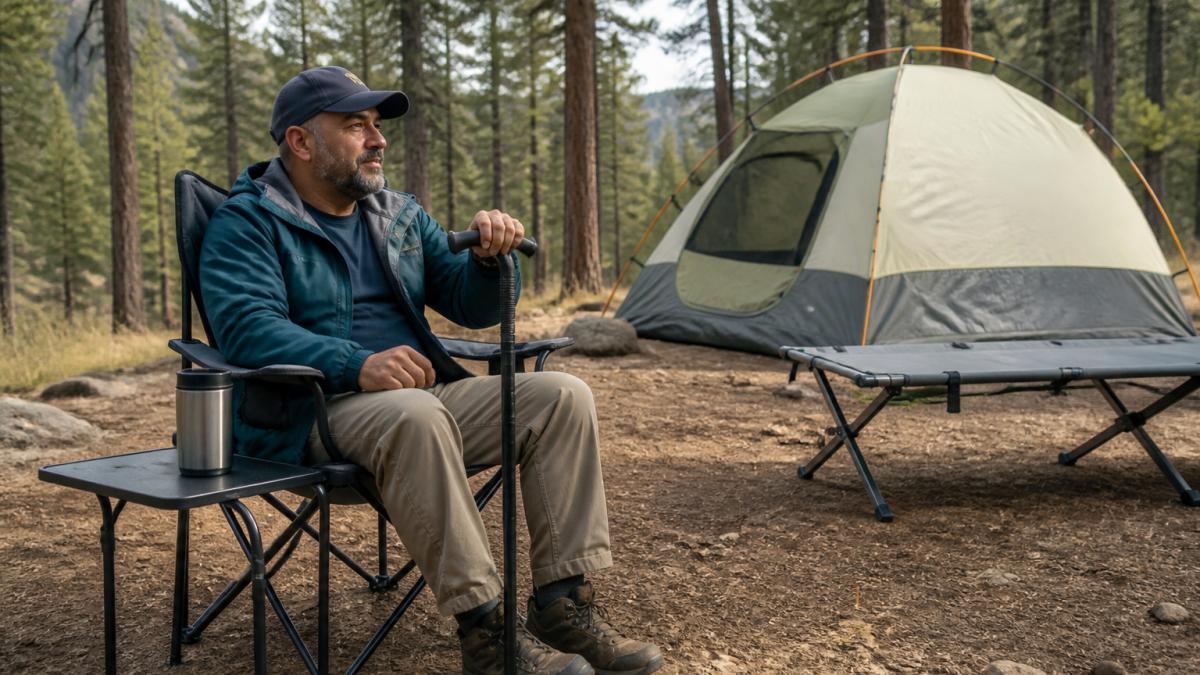
Our Folding Camping Chair with Side Table and Cup Holder ($119.99) supports up to 500 lbs on powder-coated metal tubes with firm joints.
The Directors Chair with Cooler Bag and Side Table ($151.99) supports 400 lbs on a rustproof frame and adds a cooler bag, which cuts trips back to the vehicle. Our folding hiking cane is the same aluminum model described above, and the heavy-duty cot with pad is the sleeping option we recommend first.
Mountaineering cane folding multifunctional outdoor hiking self-defense stick →


Best for: campers who need stable seating and off-ground sleeping without a helper. Skip if: you only need a chair for a paved patio, where a basic model is fine.
Durability, Maintenance, and Safety Checks
Durability is a maintenance habit as much as a material spec. A steel frame rusts if stored wet, oxford fabric weakens if packed dirty, and joints loosen if never checked. Here are concrete checks you can run on any load-bearing piece of gear.
What durability actually means by material
- Aluminum alloy frames and shafts (canes, walking supports): Light and corrosion-resistant, but thin walls dent rather than bend, and a dent concentrates stress and can fail suddenly. Inspect for dents, deep scratches, and ovalized tubing near the joint.
- Steel frames (cots, heavy-duty chairs): Strong in compression, but rust is the failure mode. Powder coating protects until it chips; a chip at a weld or foot is where rust starts. Touch up chips promptly and never store steel wet.
- Fabric (oxford cloth, PU-coated oxford, 1200D double-layer): Denier (the "D" number) indicates yarn thickness; higher denier resists abrasion and punctures better. PU coating adds water resistance but can peel or crack with age. Check seams, coating flexibility, and strap attachment points, which take the most load.
Weather and corrosion
Outdoor use means moisture, dirt, and temperature swings. Practical rules:
- Dry metal frames and fabric before storage; trapped moisture is the main cause of rust and mildew.
- Store loosely folded, never compressed under weight, so fabric and coating do not take a permanent crease.
- Keep grit out of telescoping and folding joints; grit grinds the mechanism and accelerates wobble.
Pre-trip and post-trip checks
Run this before every trip:
- Open and lock every joint, then push down hard on the frame.
- Wipe fabric dry and check seams for fraying and coating for cracking.
- Inspect foot pads for cracks or missing pieces.
- Test the cane tip for wear; replace it before it smooths out.
- Check welds and coating chips on steel frames; touch up bare metal.
- Store gear dry and loosely folded, never compressed under weight.
After the trip, repeat the fabric and joint checks and dry everything fully before storage.
Repairs and replacement parts
Replacement parts matter as much as the original build. Cane tips, foot pads, carry bags, and locking pins wear out first, and a device with no available parts becomes trash. Before buying, confirm consumable parts are replaceable and available. A simple field kit covers most failures: a spare cane tip, spare foot pads, a multi-tool, and repair tape for fabric.
Safety and fit
Stability, transfer safety, braking, and tipping risk are part of durability because a device that tips or shifts is failing at its job. Check that the device sits level on the surfaces you will actually use, that locks are fully engaged before loading, and that foot pads grip rather than skate. Fit matters too: a cane set at the wrong height changes posture and balance.
The [Consumer Product Safety Commission | cpsc.gov] maintains recall and safety information worth checking for any load-bearing outdoor product. For a full inspection routine, our guide on how to identify durable camping gear walks through what to test and when to retire a piece of equipment.
Choosing the Right Gear for Your Mobility Needs
Choosing gear starts with two questions: what terrain will you cross, and how much help do you have? Answer both honestly and the list shortens fast. Here is a framework that matches equipment to balance, strength, joint limitations, terrain, and activity.
Step 1: Match the device to the need
- Balance is the issue: Start with a folding cane or walking support. Aluminum alloy keeps it light while holding shape, and a folding design travels easily. Test the tip and height before you rely on it.
- Standing up from a low seat is the problem: Choose a higher, wider chair with armrests and firm joints. A side table keeps essentials within reach so you are not twisting to grab a drink or phone.
- Getting off the ground is impossible or painful: A cot is not a luxury. Look for one that sets up in seconds with no assembly and a frame that holds body weight without flexing.
Step 2: Match the gear to the terrain
- Paved paths and graded trails: Lighter gear is fine; a standard folding cane and a stable chair cover most needs.
- Gravel, dirt, and grass: Wider bases, non-slip foot pads, and cross-braced legs resist sinking and skating. Check that locks seat firmly under load.
- Roots, loose sand, and steep ground: This is where a full all-terrain or off-road wheelchair earns its cost, and where a pavement-rated device is a fall risk. Be honest about the ground you will actually cross.
Step 3: Check the numbers
- Weight capacity: Should exceed your body weight with margin. A chair rated at 500 lbs that lasts five seasons costs less per year than three budget chairs that fail.
- Folded size and weight: Should fit your vehicle and your arm strength. If you cannot lift and load it yourself, it will stay home.
- Setup time: Under a minute, one person, no tools. Anything requiring assembly in the dark, on uneven ground, after a long drive, will frustrate you.
Step 4: Budget, trials, and access
Buying the cheapest option and replacing it twice is a common mistake. Before buying, ask whether you can trial or rent a device, whether insurance or funding programs apply, and whether consumable parts are available. Compare total cost of ownership, including replacement tips, pads, and bags, rather than sticker price alone.
Step 5: Safety and fit
Stability, transfer safety, braking, and tipping risk belong in the buying decision, not after it. Check that the device sits level on your surfaces, that locks engage fully before loading, and that foot pads grip. Fit matters: a cane set at the wrong height changes posture and balance. When in doubt, consult a qualified clinician or equipment specialist.
A common pattern is to start with one support device and one stable seat, test them on a short trip, and add a cot or all-terrain option only after you know how you actually use the gear.
Frequently Asked Questions
What are examples of mobility devices for rough terrain?
Mobility devices for rough terrain include all-terrain wheelchairs, off-road power chairs, and sturdy canes with wide tips. For camping, folding chairs and cots with reinforced frames and non-slip feet also count as adaptive outdoor equipment. Look for features like large wheels, high ground clearance, and durable materials such as aluminum alloy or heavy-duty steel. These devices help you navigate uneven ground, gravel, and grass without losing stability.
What type of wheelchair is best for outdoor use?
An all-terrain wheelchair with large, treaded tires and a sturdy frame is best for outdoor use. Manual options are lighter and easier to transport, while power wheelchairs offer more range and reduce physical strain. Consider your terrain: gravel and roots demand wider tires and suspension, while packed trails may only need a standard off-road model. Always check weight capacity and foldability for travel.
How do I choose a wheelchair for rough terrain?
Start by assessing the terrain you'll encounter most: loose gravel, dirt paths, or grassy fields. Choose a wheelchair with wide, pneumatic tires and a high-clearance frame. Check the weight capacity and whether it folds for transport. Test the chair on similar surfaces if possible. Also consider maintenance needs, like tire repair kits and replacement parts, and ensure the chair fits your body and mobility level.
What outdoor equipment makes camping more accessible?
Accessible camping gear includes folding chairs with side tables and cup holders, cots with padded support, and canes. Look for items that require no assembly, have non-slip feet, and are made from weather-resistant materials like PVC-coated oxford cloth or powder-coated metal. These features reduce setup effort and improve stability on uneven ground, making camping more enjoyable for people with mobility issues.
How can I make outdoor trips safer for someone with limited mobility?
Plan ahead by checking trail or campsite accessibility and bringing adaptive outdoor equipment like a sturdy cane, a folding chair with armrests, and a cot that keeps you off the ground. Ensure gear is in good condition before each trip, and pack a basic repair kit. Share your itinerary with someone and carry a communication device. Choose equipment with non-slip feet and weight capacities that exceed your needs for added safety.
The real challenge is not finding gear. It is finding gear that holds when your balance, strength, or independence depends on it. North American Tactical Supply builds camping and survival equipment with honest materials and clean design, from a 500-lb folding chair to a cot that sets up in seconds with no assembly. Every piece is made to work better and last longer, so you can head out with confidence. Get started with North American Tactical Supply and gear that holds up trip after trip.
