
Table of Contents
- Why Standard Survival Gear Fails Mobility Impaired Adults
- Emergency Kit for People with Disabilities: Core Supplies That Fit Your Chair
- Wheelchair Emergency Kit: Power, Repair, and Backup Mobility
- Go-Bag Checklist for Wheelchair Users: Pack by Time and Weight
- Accessible Evacuation Plan: Routes, Transportation, and Communication
- Accessible Storage, Carrying, and Weight Distribution
- Conclusion: Build a Kit You Can Actually Use
- Frequently Asked Questions
Last Updated: October 18, 2026
Why Standard Survival Gear Fails Mobility Impaired Adults
Most survival kits are built for someone who can walk out of a building, carry 20 kilograms on their back, and set up a tent in the dark. That is not the reality for millions of Americans.
At North American Tactical Supply, we build gear around one question: can the person using it actually deploy it alone, under stress, without help? That question reshapes everything.
The core failures are predictable:
- Weight. A loaded backpack is dead weight when your hands are on wheelchair rims or a walker.
- Setup. A tent that needs two hands and a crouch is useless to someone who cannot crouch.
- Power. A powered wheelchair without a backup plan becomes a 150-kilogram object.
- Reach. Supplies stored in a high cabinet might as well not exist.
Disability preparedness is not about buying more gear. It is about buying the right gear and storing it where you can reach it.
Emergency Kit for People with Disabilities: Core Supplies That Fit Your Chair
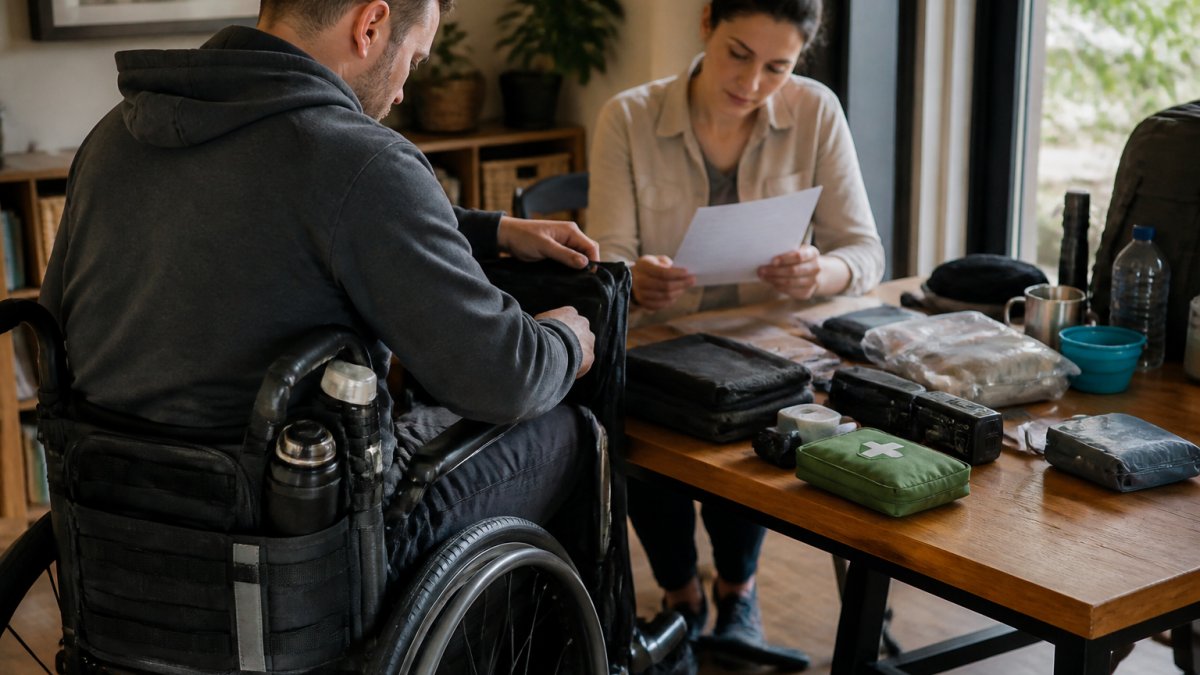
An emergency kit for people with disabilities is a compact, reachable set of supplies chosen for your specific mobility device, not a generic box. It should cover water, food, medication, and hygiene for at least 72 hours, and it should mount on or beside your chair.
Start with the container. A soft-sided bag that straps to the back of a wheelchair, or a small rigid case that fits a walker basket, beats a large duffel you cannot lift.
Water, Food, and Medication Storage
Water is the heaviest item in any kit, so treat it as a weight budget. Our water purification straw weighs almost nothing and needs no pumping or batteries. For stored water, purification tablets are the lightest backup: one strip treats 10 liters and costs less than a dollar.


Food should be nonperishable, low-weight, and openable without a can opener. Think pouches, bars, and comfort snacks you will actually eat under stress.
Medication is the item people forget to rotate. Keep a 7-day supply in a labeled pouch, plus a printed list of every prescription, dose, and pharmacy. Add a medical alert tag or card listing conditions, allergies, and emergency contacts.
Hygiene and Toileting Supplies
Toileting is the part most guides skip, and it is the part that decides whether a shelter stay is bearable. Pack:
- Wet wipes and hand sanitizer
- Disposable bags and ties
- A small bottle of bleach-free sanitizer for surfaces
- Spare underwear and absorbent products
- A lightweight urinal or bedpan if you cannot transfer independently
Keep this kit in its own labeled pouch so a caregiver can find it fast.
Wheelchair Emergency Kit: Power, Repair, and Backup Mobility
A wheelchair emergency kit is the set of spare parts, tools, and power backups that keep your chair rolling when the usual support is gone. For manual chairs, that means tires and tools. For powered chairs, it means a plan for the grid going down, and that plan is where most preparedness guides go silent.
Power Failure Planning for Powered Wheelchairs
Power failures are the biggest blind spot in disability preparedness. A powered wheelchair is only as good as its battery, and the grid is the first thing to fail in a storm.
Start by knowing your numbers. Check your chair's manual or battery label for two figures: battery capacity in amp-hours (Ah) and the chair's typical draw in amps. A common group 24 sealed lead-acid battery is rated around 70-80 Ah, but usable capacity is lower and declines with age and cold.
Build a layered plan:
- Charge discipline. Keep the chair charged above 80% whenever a storm is forecast, and charge overnight before any expected outage. Cold reduces lead-acid capacity noticeably, so store the chair indoors in winter.
- Backup power sized to the task. A portable power station with a standard AC outlet can recharge a chair's onboard charger for a partial top-up, but check the station's continuous wattage against your charger's draw before relying on it. Our portable solar power station runs lighting for up to 30 hours and charges small devices by solar or adapter, treat it as a phone-and-radio lifeline first, and confirm it can handle your chair charger before counting on it for mobility.
- Spare batteries and chargers. If your chair uses removable batteries, keep a charged spare and a second charger. Store the spare at room temperature, not in a cold garage.
- Manual fallback. Keep a manual chair, walker, or cane as a backup. Our folding mountaineering cane folds small and doubles as a support tool.
- Documentation. Keep a printed card with your chair's make, model, battery type, charger voltage, and the manufacturer's service number. If you must evacuate to a shelter, that card lets staff find a compatible charger or battery faster.
Device-Specific Repair and Maintenance Kits
Every chair needs a small repair pouch matched to its parts:

- Manual chairs: tire patch kit, pump, Allen keys, spare tube, brake adjustment tool
- Powered chairs: spare charger, fuse, joystick cover, and the manufacturer's service number
- Scooters and walkers: spare battery, rubber tips, and tightening tools
Label the pouch and store it on the chair, not in a closet. A repair kit you cannot reach is a repair kit you do not have.
Go-Bag Checklist for Wheelchair Users: Pack by Time and Weight
A go-bag checklist for wheelchair users should be organized by how fast you need to leave and how much weight your chair can carry. Pack in three tiers: grab-and-go, shelter, and extended stay.
Mountaineering cane folding multifunctional outdoor hiking self-defense stick →
| Tier | Time to Leave | Weight Target | What Goes In |
|---|---|---|---|
| Grab-and-go | Under 5 minutes | Under 2 kg | Medication, phone, charger, ID, alert tag, cash, keys |
| Shelter | 15 minutes | Under 8 kg | Water filter, snacks, wipes, blanket, spare clothes |
| Extended stay | 1 hour | Under 15 kg | Tent or tarp, bedding, repair kit, power station |
Weigh each tier on a luggage scale. If a tier exceeds its target, cut until it fits. A bag you cannot lift is not a go-bag.
Accessible Evacuation Plan: Routes, Transportation, and Communication
An accessible evacuation plan is a written route and transport plan that accounts for your mobility device, plus a communication chain that works when phone lines are jammed. It must be practiced, not just printed. Most guides stop at "have a plan." This one goes into the details that decide whether the plan actually works.
Routes and Shelter Accessibility
Map two exits from every room you use. Confirm both are wide enough for your chair and free of thresholds. Measure the narrowest doorway on each route and write the number down, a standard interior door is about 32 inches wide, and many chairs need close to that.
Call ahead to your likely shelters, a local school, community center, or designated emergency shelter, and ask three questions: Is there a step-free entrance? Are there accessible restrooms? Can a service animal stay? Record the answers on your plan.
Transportation Contingencies
Transportation is where plans break. Most emergency buses are not wheelchair accessible, and paratransit service is often suspended or overwhelmed during a large evacuation. Line up at least three options in advance and write them on paper:
- A neighbor or family member with an accessible vehicle. Ask specifically whether the vehicle has a ramp or lift and whether the driver can assist with a transfer. Confirm the vehicle can carry your chair or scooter, not just you.
- A local paratransit or accessible transit service. Save the number offline and ask in advance what their emergency policy is, many prioritize dialysis and medical trips first.
- A ride service. Note your device type and transfer needs in the app profile, and keep a phone charger in your grab-and-go bag so you can book when power is out.
Plan your transfer. If you need assistance getting into a vehicle, identify two people who can help and confirm they know your transfer method. Practice once, calmly, before you need it.
Caregiver Coordination and Emergency Contacts
Write a one-page care plan. Include your conditions, medications, device models, transfer needs, and who to call. Give copies to two caregivers and keep one taped inside your kit.
Set a check-in schedule: a text at a set time, and a backup call if no reply within 30 minutes. Store contacts on paper as well as in your phone. Decide in advance what a caregiver should do if they cannot reach you, who they call, and whether they should come to you or go to the meeting point.
Accessible Storage, Carrying, and Weight Distribution
Storage decides whether your kit works. Put supplies where you can reach them from a seated position: low shelves, chair-mounted bags, and a bedside caddy.
Distribute weight low and centered on the chair. Heavy items go in the bag closest to the axle. Keep the grab-and-go pouch on your lap or within arm's reach.
For home caches, use clear bins with labels at wheelchair height. Rotate food, water, and medication every six months with a calendar reminder.
Conclusion: Build a Kit You Can Actually Use
The hardest part of preparedness is not buying gear. It is admitting that the standard kit was never designed for you, then building one that was.
Start with the grab-and-go tier this week. Weigh it, time it, and test it from your chair. Then add power, repair, and evacuation plans one layer at a time.
At North American Tactical Supply, we build all-in-one kits with honest materials and clean design so they work better and last longer. Our gear is made for people who need it to hold up when it counts.
Frequently Asked Questions
What survival gear should adults with limited mobility keep in an emergency kit?
Start with a seven-day supply of medications in original bottles, a written medication list, and a first aid kit. Add water (1 gallon per person per day) and a purification method like the Water Purification Straw ($14.99) or purification tablets. Include nonperishable food, a hygiene kit, backup mobility aids such as a folding cane ($49.80), spare batteries and chargers, a headlamp, and a medical alert tag. Pack everything in a bag that attaches to your wheelchair or scooter so your hands stay free.
How can wheelchair users prepare for an emergency evacuation?
Map two accessible exit routes from your home and workplace, noting elevators, ramps, and wide doorways. Identify a buddy or caregiver who knows how to assist you and where your chair is stored. Register with your local emergency management office if they keep a functional needs registry. Keep a lightweight backup mobility device and an accessible transportation contact list. Practice the route twice a year, and store a small go-bag on your chair so you can leave without searching for supplies.
How should you prepare a powered wheelchair for a power outage?
Charge the chair daily and keep a spare battery or charger at a second location. A portable solar power station ($55.00) with USB and 6V outputs can keep communication devices and small electronics running, though check your chair's manual for specific charging requirements. Have a manual wheelchair or transport chair as a backup. Store a headlamp, extra batteries, and a printed list of repair contacts. If you rely on a ventilator or other powered medical device, register with your utility company's medical priority list.
What should go in a go-bag for a person with limited mobility?
Pack by time and weight: a small pouch on your chair for medications, ID, phone, and a charger; a medium bag for 24 hours of food, water, and hygiene items; and a larger bag at home for 72 hours of supplies. Keep the total weight under what you can push or carry. Include a folding cane, backup glasses, hearing aid batteries, a phone with a backup battery, a list of emergency contacts, and a comfort item. Label every bag and review it every six months.